
Facial plastic surgery
Facial plastic surgery, also known as a facelift or rhytidectomy, is a surgical procedure designed to improve the visible signs of aging of the face and neck. It involves various techniques aimed at tightening the skin, eliminating wrinkles, and correcting fallen facial tissues.
Undergoing facial plastic surgery may be justifiable in a variety of cases, including:
- Signs of aging: Wrinkles, loss of firmness, and sagging skin that may be visible with age may be reason to undergo a facial plastic surgery.
- Desire to improve appearance: Individuals seeking to improve their appearance may see a plastic surgeon to correct the shape of the face and give a more youthful or harmonious appearance.
- Gerontological changes: Deep creases and changes in skin texture caused by aging can be corrected with plastic surgery.
- Sagging tissue: If facial tissues are sagging, affecting the contours and overall shape of the face, facial plastic surgery can help tighten the skin and restore its elasticity.
- Genetic features: Hereditary factors, such as facial structure features, may also be grounds for plastic corrections.
- Последствия траConsequences of trauma or surgery: Recovering from trauma or surgical interventions may also require plastic surgery to restore a natural appearance.вмы или хирургических вмешательств: Восстановление после травмы или хирургических вмешательств может также потребовать пластической коррекции для восстановления естественного вида.
It is important to note that each case is different and the decision to undergo facial plastic surgery should be made after careful consultation with a qualified plastic surgeon.
There are many different types of facial plastic surgery that are designed to improve appearance and eliminate signs of aging. :
Some of these include:
A procedure aimed at tightening the facial skin, eliminating deep wrinkles, reducing the volume of soft tissues of the face.
There are several types of facelift:
✔ Traditional facelift (full facelift): Includes incisions along the hairline, behind the ears and possibly under the chin to access muscles and tissues.
✔ Mini lift (Short Scar or S-Lift): Less extensive surgery with shorter incisions, focusing on tightening specific areas of the face.
✔ Mid-Facelift (Mid-Facelift): The main focus is on the central part of the face, including the cheekbones and nasolabial folds.
The choice of a particular method depends on specific factors such as skin condition, muscle condition, anatomy and the patient’s wishes.
The operation is performed under general anaesthesia.
Rehabilitation period:
– First days: Swelling and bruising, slight pain, rest is required.
– First week: Most patients return to daily life, but may have limitations in physical activity.
– First 2-4 weeks: Swelling and bruising gradually decreases but may persist. Physical activity limitations may occur at this stage.
– First 3-6 months: Scar healing and finalisation of the results of the Facelift.
As with any surgical procedure, it is important to get detailed advice and instructions from your surgeon for optimal recovery.
Indications for eyebrowplasty are the correction of the shape and position of the eyebrows to create a more open look of a lifted upper eyelid, sagging eyebrow, deep forehead wrinkles, cosmetic corrections.
There are several methods and types of surgery:
✔ Classic browlift (coronal): An incision is made in the forehead area, usually at the hairline, to raise the eyebrows and remove excess skin.
✔ Brow lift using endoscopy: A less invasive technique that uses an endoscope to visualise and lift the eyebrows through small incisions.
✔ Minimal Incision Brow Lift (S-Lift): Shorter incisions focusing on lifting the outer corner of the eyebrows.
The surgery is performed under general anaesthesia.
Rehabilitation period:
– First few days: There may be swelling and bruising. Rest, cold compresses are required.
– First week: Most patients can return to normal activities, but with limited physical activity.
– First 2-4 weeks: Swelling and bruising decreases, mild activity restrictions may occur.
– First 3-6 months: Scar healing and finalisation of brow lift results.
As with any surgical procedure, it is important to get detailed recommendations and instructions from your surgeon for optimal recovery.
Surgery aimed at removing excess skin, fat and bags in the upper and/or lower eyelid area that affects the overall contour of the eyelids and gives an aged appearance.
There are several methods and types of surgery:
✔ Upper blepharoplasty: Removal of excess skin, muscle and fat from the upper eyelid through an incision in the natural crease.
✔ Lower blepharoplasty: Removal of excess skin, fat and correction of bags under the eyes, often using incisions within the lower eyelid or under the eyelashes.
✔ Transconjunctival blepharoplasty: A procedure in which an incision is made inside the lower eyelid to reduce the appearance of scarring.
The operation is performed under local anaesthesia, possibly combined with sedation or general anaesthesia in the presence of other surgical procedures.
Rehabilitation period:
– First few days: Swelling and bruising may occur. Rest, and cold compresses are required.
– First week: Most patients can return to normal activities, but with limited physical activity.
– First 2-4 weeks: Swelling and bruising decreases, mild activity restrictions may occur.
– First 3-6 months: Scar healing and finalisation of blepharoplasty results.
As with any surgical procedure, it is important to get detailed advice and instructions from your surgeon for optimal recovery.
Removal of excess fat in the chin, cheeks, neck or jawline area of the face to improve contours.
There are several methods and types of surgery:
✔ Radiation liposuction: A procedure in which the surgeon inserts a cannula through a small incision and sucks up the excess fat.
✔ Vibroliposuction: The use of a vibrating cannula to extract fat more easily.
✔ Ultrasonic Liposuction: The use of ultrasound to destroy fat cells before they are sucked out.
✔ Laser liposuction: A procedure that uses a laser to destroy fat cells.
It is performed under general or local anaesthesia depending on the extent of the surgery.
Rehabilitation period:
– First few days: Swelling, bruising and some pain. Wearing a compression bandage is required.
– First week: Most patients can return to normal activities, but with limited physical activity.
– First 2-4 weeks: Swelling and bruising diminish, mild activity restrictions may occur.
– First 3-6 months: Scar healing and finalisation of liposuction results.
It is important to follow the surgeon’s instructions and follow the care advice for the treatment area to minimise the risks and achieve the best results.
Внедрение имплантов для объем подбородка или скул, при наличие дефектов в структуре костей, требующих коррекции, а так же улучшение эстетики лица и придание ему более симметричного вида.
Существует несколько методов и видов операции:
✔ Импланты подбородка: Вставка импланта под мышцы подбородка для улучшения его формы и профиля.
✔ Импланты скул: Размещение имплантов в области скул для создания или улучшения объема и контуров.
Операция проводится под общей анестезией.
Реабилитационный период:
– Первые несколько дней: Отек, синяки и дискомфорт. Необходимо соблюдать покой и избегать интенсивных физических упражнений.
– Первая неделя: Большинство пациентов может вернуться к обычной деятельности, но с ограничением по физической активности.
– Первые 2-4 недели: Отек и синяки уменьшаются, возможны легкие ограничения на активности.
– Первые 3-6 месяцев: Заживление рубцов и окончательное освоение результатов. Рекомендуется регулярное наблюдение у хирурга.
Для уменьшения возможных осложнений и достижения наилучших результатов необходимо строго следовать рекомендациям врача относительно ухода и ограничений в период реабилитации.
The surgical removal of an aesthetic defect in which excessive fat accumulation or sagging of the skin under the chin forms which creates the visual effect of an additional second chin.This defect may be due to factors such as aging genetics being overweight or general muscle tone.
Various procedures are available to correct a double chin:
✔ Chin Liposuction: Removes excess fat from the area under the chin using a thin cannula.
✔ Chin lift: Eliminates sagging skin and improves the contour of the chin by removing excess skin and tightening the tissue.
✔ The specific method depends on the individual patient and the nature of the defect. Before undergoing any procedure, it is important to consult with an experienced surgeon who can suggest the best treatment plan for your case.
It is carried out under general or local anaesthesia, depending on the type of surgery.
Rehabilitation period:
– First few days: Swelling, bruising and discomfort. Wearing a compression bandage may be recommended.
– First week: Patient can return to normal activities, but with restrictions on physical activity.
– First 2-4 weeks: Swelling and bruising gradually decrease. Avoidance of strenuous exercise is recommended.
– First 3-6 months: Scar healing and finalisation of results.
It is important to follow the surgeon’s instructions and follow the care advice for the treatment area to minimise the risks and achieve the best results.
Otoplasty is a surgical procedure to change the shape and size of the ears, often to improve their appearance and their proportions.
The indications for this surgery are usually to correct the position of the cartilage of the auricle or to remove excess skin to reshape the ears.
Indications for surgery
✔ Lagging ears: When the ears protrude too far forward.
✔ Ear asymmetry: Unbalanced shape or positioning of the ears.
✔ Post-injury correction: To restore the shape of the ears after trauma or unsuccessful previous surgery.
Performed under general or local anaesthesia depending on the extent of the operation.
Rehabilitation period:
First few days: Swelling, bruising and discomfort. Wearing a special bandage is recommended.
– First week: The patient can return to normal activities, but with restrictions on physical activity.
– First 2-4 weeks: Swelling and bruising gradually decrease. It is recommended to avoid intense physical activity.
– First 3-6 months: Scar healing and finalisation of results.
It is important to obtain detailed advice from the surgeon for the individual case and follow it strictly to achieve optimal results and minimise risks.
The neck lift procedure is a surgical procedure to correct sagging and excess skin in the neck and lower face.
It is performed under general or local anaesthesia depending on the extent of the surgery.
Excess skin is removed and the muscles and tissues are tightened to restore the elasticity and shape of the neck.
There are several different surgical techniques in neck lift surgery and the choice of method depends on the individual patient, the degree of sagging tissue and the desired effect.
The choice of a particular method depends on individual factors such as skin condition, muscle condition, anatomy and the patient’s wishes.
Rehabilitation period:
– First few days: There may be swelling and bruising. Rest, and cold compresses are required.
– First week: Most patients can return to normal activities, but with limited physical activity.
– First 2-4 weeks: Swelling and bruising decreases, mild activity restrictions may occur.
– First 3-6 months: Scar healing and finalisation of neck lift results.
As with any surgical procedure, it’s important to get detailed advice and instructions from your surgeon for optimal recovery.
How does our interaction take place?

Contact Us
We take your enquiry with your preferences and forward the appropriate information to the clinics.

We provide the best medical solutions!
We consult with clinics to provide you with the best options, taking into account pricing, specialist qualifications and your requirements.

In co-operation with the clinic, we create a plan for your arrival
Once you have chosen your preferred clinic and doctor, our first priority is to carefully handle all organisational matters to ensure your ultimate comfort.

Always in touch
Upon arrival in Turkey, we will ensure your comfort in the hospital and the accompaniment of our counsellors throughout the process. We are available 24/7 to help and support you with your questions so that you can focus on your treatment in peace.
There is no extra charge for our services
We are committed to finding the most effective and efficient treatments in our country for your specific needs.
Our services are financed by medical centres.
Any possible payments are made directly at the clinics’ counters.
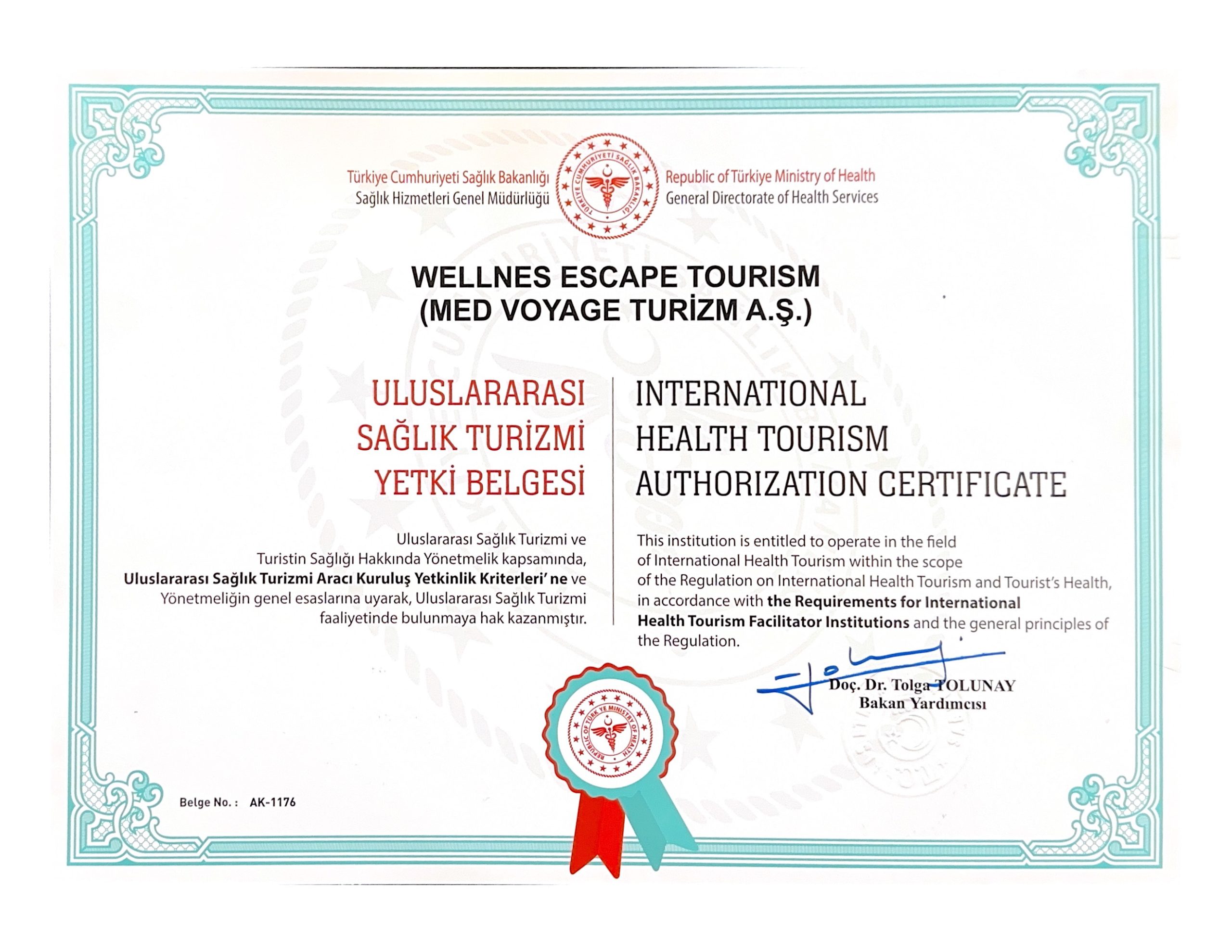
Our company holds an official licence issued by the Turkish Ministry of Health to carry out activities in the field of medical tourism and engage with patients and medical institutions in Turkey.